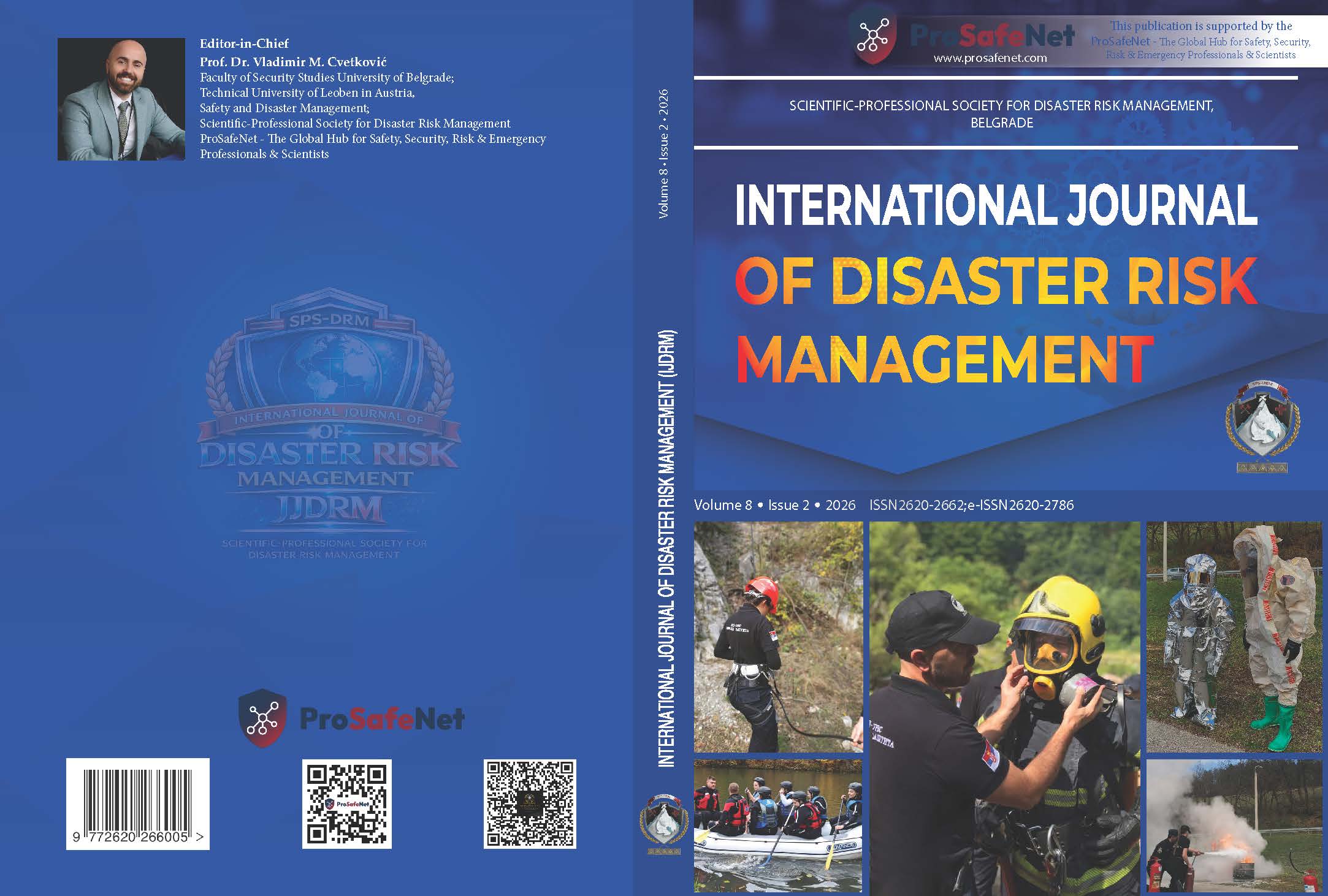
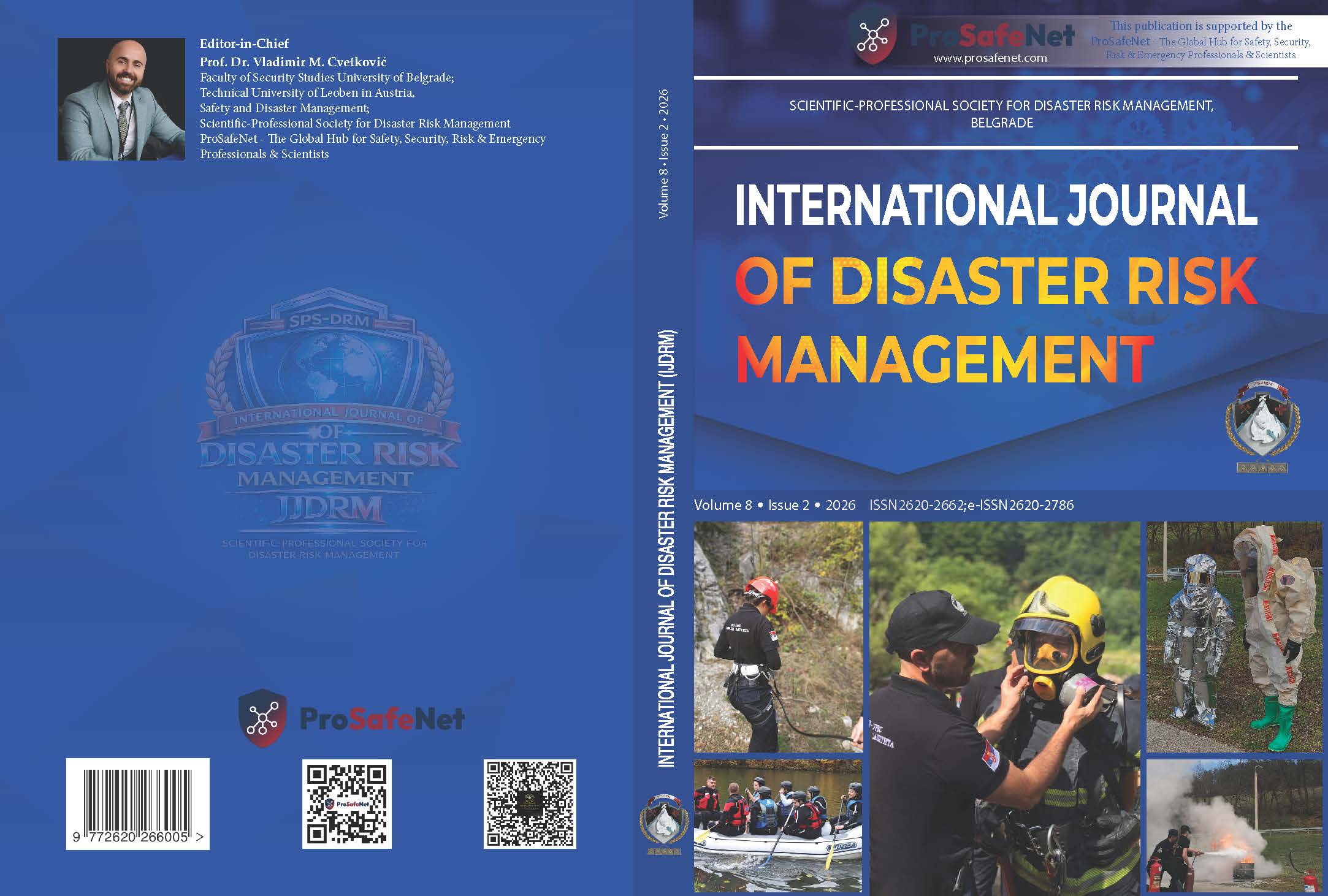
Vol. 8 No. 2 (2026): International Journal of Disaster Risk Management

Volume 8, No. 2 (2026) of the International Journal of Disaster Risk Management (IJDRM) follows a rolling (continuous) publication model. Articles are published online individually as soon as they have successfully completed the rigorous double-blind peer-review process and the full production workflow, including copyediting, typesetting, layout, and final proof approval.
New articles will be added to this issue throughout the publication period until it is formally closed. This model accelerates the dissemination of rigorously reviewed research and ensures that new findings become available to researchers, practitioners, policymakers, emergency-management professionals, and the wider international community without unnecessary delay. Readers are encouraged to visit this page regularly to access the latest articles as they are published.
Call for Papers
IJDRM welcomes high-quality original research articles, review papers, case studies, and practice-oriented contributions addressing all phases of disaster risk management, including risk prevention and mitigation, preparedness, response, recovery, and reconstruction.
The journal covers a broad range of topics related to natural and technological hazards, climate-related and cascading risks, complex emergencies, societal and community resilience, vulnerability assessment, critical infrastructure protection, risk communication, emergency management, disaster governance, and emerging challenges in disaster risk reduction.
IJDRM particularly encourages interdisciplinary, comparative, innovative, and internationally relevant research that advances disaster risk management theory, policy, and practice. Submissions from researchers and practitioners worldwide are warmly welcomed, including studies representing diverse geographical, institutional, social, and cultural contexts.
All submitted manuscripts undergo initial editorial screening and, when found suitable for the journal, rigorous double-blind peer review. Following successful peer review and completion of the production process, accepted articles are published promptly within this issue. Each published article is assigned a DOI and made freely available under the Creative Commons Attribution 4.0 International License (CC BY 4.0).
There are no manuscript-submission or peer-review fees. An Article Processing Charge of EUR 150 applies only after a manuscript has been formally accepted for publication. Further information is available on the journal’s Publication Fees page.
Prospective authors are invited to consult the Author Guidelines and submit their manuscripts through the journal’s online submission system.
Published:
2026-08-03