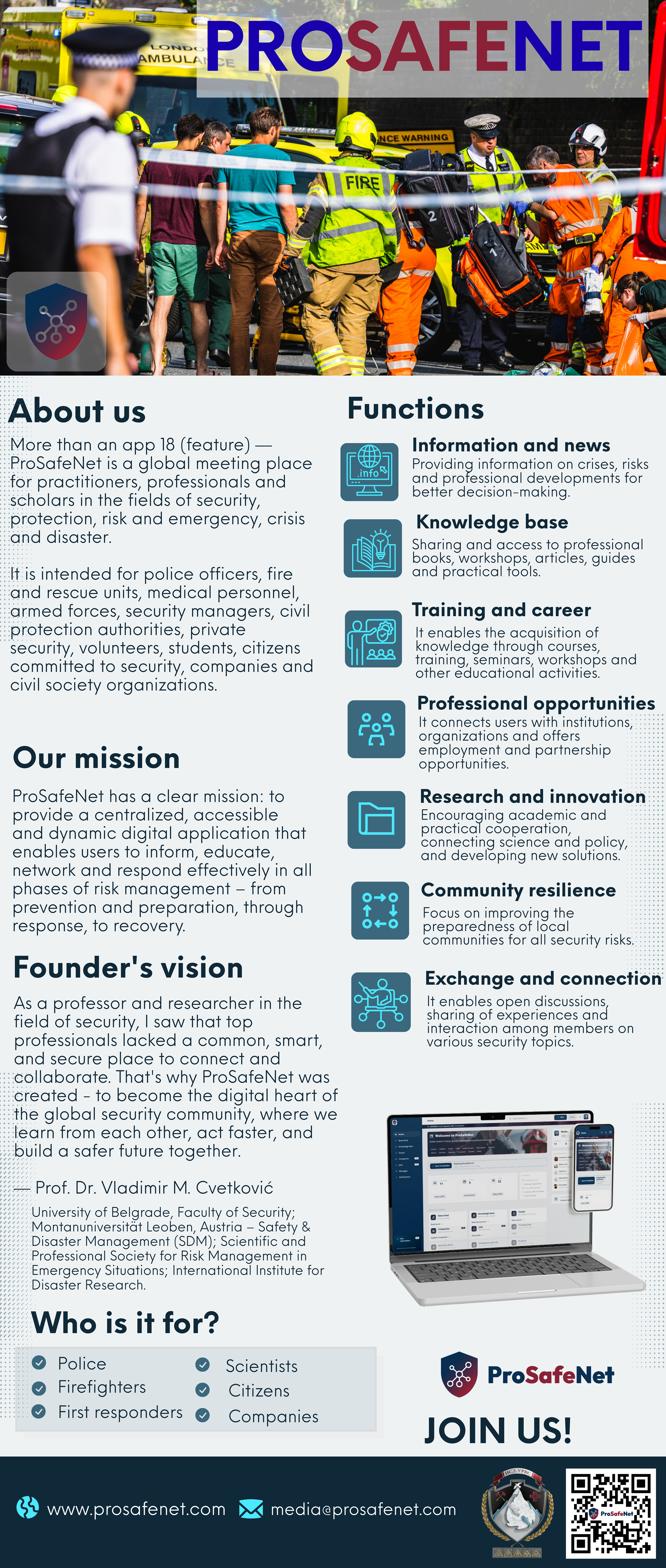
Supported by: ProSafeNet - The Global Hub for Safety, Security, Risk & Emergency Professionals & Scientists
ProSafeNet is free social network application that allows members to share knowledge and experience, connect, train, innovate, respond to emergencies, and access real-time tools - turning expertise into action for a safer, more resilient world.
More than a application — ProSafeNet is the global meeting place for safety, security, risk, and emergency (crisis, disaster) practitioners, professionals, and scientists — including police officers, firefighting and rescue units, medical personnel, military forces, security managers, civil protection authorities, private security, volunteers, students, safety-conscious citizens, companies, and NGOs.
They come together here to share knowledge and experience, connect, train, innovate, respond to emergencies, and access real-time tools — from news, research, and policy labs to jobs, security alerts, volunteering, and community resilience hubs — turning expertise into action for a safer, more resilient world. Built by experts, for experts — to enable more intelligent decisions, faster action, and stronger bonds through powerful tools, real-time intelligence, and global collaboration.
In an era of increasingly complex and global risks - from pandemics and climate-related disasters to cyber threats, hybrid crises, and systemic vulnerabilities - the demand for collaborative, timely, and expert-driven solutions has never been greater. Yet, the international safety and emergency community remains fragmented, often lacking tools for real-time connection, shared learning, and coordinated response.
ProSafeNet is changing that. ProSafeNet is an intelligent digital platform designed to connect, empower, and support professionals and institutions working in the fields of safety, security, disaster risk reduction, crisis response, public health, and emergency management - across sectors and across borders.
ProSafeNet is a dynamic digital environment created to empower professionals, institutions, and communities working in the fields of safety, security, disaster risk reduction, and emergency management. With an expanding set of intelligent tools and collaborative spaces, the platform facilitates knowledge exchange, operational coordination, and professional development across sectors and borders.
Whether you're responding to emergencies, designing policy, leading community initiatives, conducting research, or training the next generation, ProSafeNet provides the digital infrastructure to support your mission. Below is an overview of the platform’s key features – carefully designed to meet the evolving needs of the global safety and resilience community.
- News Feed – Explore updates and share professional content across the safety and crisis management community. Stay informed about new projects, incidents, institutional actions, and expert opinions. The feed supports images, documents, and mentions to increase engagement and visibility.
- Knowledge Base – Access and contribute expert articles, tools, guides, and practical documents.
Users can comment on content, provide feedback, and tag materials by topic and relevance. It is a growing repository of real-world knowledge built by and for practitioners. - Events – Browse and register for trainings, webinars, conferences, and collaborative sessions.
Events can be filtered by language, location, format, and sector. Organizers can upload supporting materials and share recordings post-event. - Companies – Discover and connect with organizations, institutions, and safety-related service providers. Company pages display missions, contact info, and activity logs. This feature boosts professional visibility and enables partnership opportunities.
- Jobs – Search or post employment, volunteer, and contract-based opportunities in relevant sectors.
Users can mark jobs as “volunteer” or “contract” and apply directly or externally. Job seekers can also follow organizations and receive updates on new openings. - Security Alerts – Receive real-time warnings and updates on ongoing threats and incidents.
Alerts include information on natural hazards, infrastructure disruptions, and other critical risks. Designed to improve situational awareness and rapid response. - Training Hub – Participate in courses, simulations, and earn digital certificates to develop your skills. Courses range from beginner to advanced and include downloadable resources and quizzes. Certificates are automatically issued and saved in the user's portfolio.
- Emergency Aid Hub – Coordinate urgent support, mobilize resources, and respond to crisis situations effectively. Organizations and individuals can report needs or offer assistance with full traceability. The hub facilitates rapid coordination during emergencies.
- Projects – Initiate or join international cooperation and multi-partner safety initiatives.
Project owners can outline goals, invite collaborators, and update progress. The module supports visibility, transparency, and impact reporting. - Research Hub – Share research ideas, collaborate on academic projects, and build research networks. Users can create researcher profiles, track calls for papers, and exchange data or tools. The hub promotes interdisciplinary and cross-border academic exchange.
- Policy Practice Lab – Bridge research with policy and field operations through shared insights and briefs. Policymakers can access practice-oriented summaries of research and engage directly with authors. Real-world challenges can be submitted to the academic community for solution development.
- Innovation Lab – Participate in challenges, co-create solutions, and showcase safety innovations.
Users can test prototypes, give structured feedback, and participate in design workshops. Institutions, universities, or public authorities can initiate innovation challenges. - Community Resilience Hub – Highlight local actions, tools, and stories that strengthen community preparedness. Citizens, schools, and local organizations can share practices and collaborate. The hub supports bottom-up resilience and public awareness initiatives.
- Risk Intelligence Hub – Monitor live data, track threat trends, and access expert-driven analysis.
Interactive dashboards, maps, and expert commentary help interpret dynamic risk environments. Users can report local threats anonymously and contribute to situational mapping. - Youth & Early-Career Hub – Access opportunities, guidance, and peer connections for young professionals. The space includes mentorship, internships, and project-based learning. Students can publish theses, receive feedback, and build their academic portfolio.
- Shops – Browse and offer safety tools, training services, professional literature, and digital resources. Vendors can list products with pricing, availability, and delivery options. Buyers can rate services and contact sellers directly through the platform.
- Volunteering Hub – Join engagement opportunities, log your impact, and earn certificates and recognition. Volunteers can browse missions by type, location, and time availability. Participation history is saved in a personal journal, visible in the user’s profile.
- Forum – Join open discussions and exchange knowledge on safety-related topics.
Forums are moderated by topic and allow structured debates, Q&A, and community polls. Users can follow threads, bookmark posts, and contribute long-form commentary.