Archives
-

International Journal of Disaster Risk Management
Vol. 8 No. 2 (2026)Volume 8, No. 2 (2026) of the International Journal of Disaster Risk Management (IJDRM) follows a rolling (continuous) publication model. Articles are published online individually as soon as they have successfully completed the rigorous double-blind peer-review process and the full production workflow, including copyediting, typesetting, layout, and final proof approval.
New articles will be added to this issue throughout the publication period until it is formally closed. This model accelerates the dissemination of rigorously reviewed research and ensures that new findings become available to researchers, practitioners, policymakers, emergency-management professionals, and the wider international community without unnecessary delay. Readers are encouraged to visit this page regularly to access the latest articles as they are published.
Call for Papers
IJDRM welcomes high-quality original research articles, review papers, case studies, and practice-oriented contributions addressing all phases of disaster risk management, including risk prevention and mitigation, preparedness, response, recovery, and reconstruction.
The journal covers a broad range of topics related to natural and technological hazards, climate-related and cascading risks, complex emergencies, societal and community resilience, vulnerability assessment, critical infrastructure protection, risk communication, emergency management, disaster governance, and emerging challenges in disaster risk reduction.
IJDRM particularly encourages interdisciplinary, comparative, innovative, and internationally relevant research that advances disaster risk management theory, policy, and practice. Submissions from researchers and practitioners worldwide are warmly welcomed, including studies representing diverse geographical, institutional, social, and cultural contexts.
All submitted manuscripts undergo initial editorial screening and, when found suitable for the journal, rigorous double-blind peer review. Following successful peer review and completion of the production process, accepted articles are published promptly within this issue. Each published article is assigned a DOI and made freely available under the Creative Commons Attribution 4.0 International License (CC BY 4.0).
There are no manuscript-submission or peer-review fees. An Article Processing Charge of EUR 150 applies only after a manuscript has been formally accepted for publication. Further information is available on the journal’s Publication Fees page.
Prospective authors are invited to consult the Author Guidelines and submit their manuscripts through the journal’s online submission system.
-

International Journal of Disaster Risk Management
Vol. 8 No. 1 (2026)Vol. 8, No. 1 (2026) is published using a rolling (continuous) publication model. Articles are published online individually as soon as they successfully complete double-blind peer review and the full production workflow (copyediting, typesetting/layout, and final proofing). This issue will be updated continuously until it is formally closed, ensuring that new research becomes available to readers without unnecessary delay. We invite you to visit this page regularly to follow the latest publications as they appear. Call for authors: IJDRM welcomes high-quality original research, reviews, and practice-oriented contributions across the full disaster risk management cycle—prevention, preparedness, response, recovery, and mitigation—covering natural hazards, technological hazards, complex emergencies, and emerging risks. Authors are warmly encouraged to submit their manuscripts via the journal’s online system; accepted articles are published promptly under this continuous publication model.
-
International Journal of Disaster Risk Management
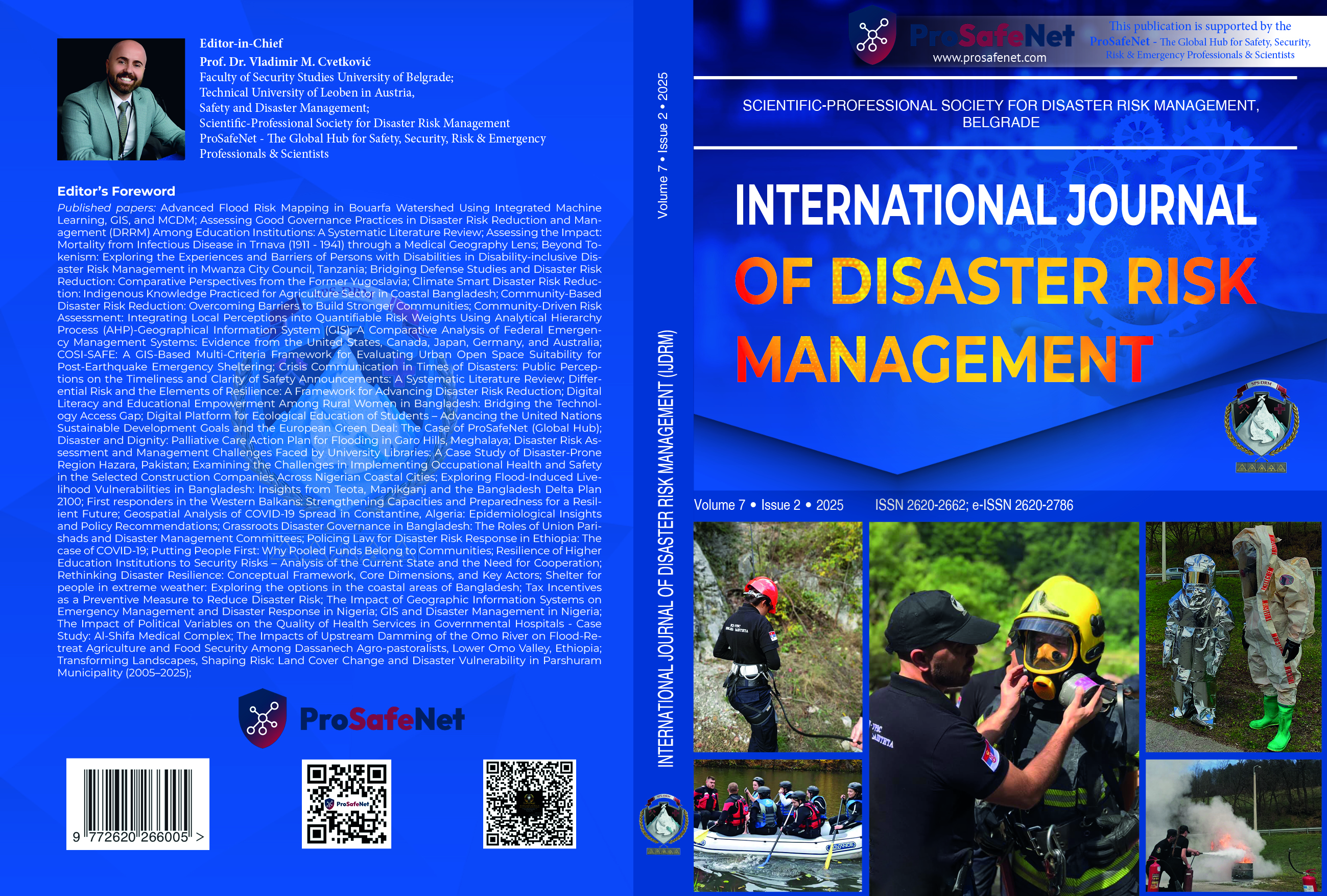
Vol. 7 No. 2 (2025)Published papers: Advanced Flood Risk Mapping in Bouarfa Watershed Using Integrated Machine Learning, GIS, and MCDM; Assessing Good Governance Practices in Disaster Risk Reduction and Management (DRRM) Among Education Institutions: A Systematic Literature Review; Assessing the Impact: Mortality from Infectious Disease in Trnava (1911–1941) through a Medical Geography Lens; Beyond Tokenism: Exploring the Experiences and Barriers of Persons with Disabilities in Disability-inclusive Disaster Risk Management in Mwanza City Council, Tanzania; Bridging Defense Studies and Disaster Risk Reduction: Comparative Perspectives from the Former Yugoslavia; Climate Smart Disaster Risk Reduction: Indigenous Knowledge Practiced for Agriculture Sector in Coastal Bangladesh; Community-Based Disaster Risk Reduction: Overcoming Barriers to Build Stronger Communities; Community-Driven Risk Assessment: Integrating Local Perceptions into Quantifiable Risk Weights Using Analytical Hierarchy Process (AHP)-Geographical Information System (GIS); A Comparative Analysis of Federal Emergency Management Systems: Evidence from the United States, Canada, Japan, Germany, and Australia; COSI-SAFE: A GIS-Based Multi-Criteria Framework for Evaluating Urban Open Space Suitability for Post-Earthquake Emergency Sheltering; Crisis Communication in Times of Disasters: Public Perceptions on the Timeliness and Clarity of Safety Announcements: A Systematic Literature Review; Differential Risk and the Elements of Resilience: A Framework for Advancing Disaster Risk Reduction; Digital Literacy and Educational Empowerment Among Rural Women in Bangladesh: Bridging the Technology Access Gap; Digital Platform for Ecological Education of Students – Advancing the United Nations Sustainable Development Goals and the European Green Deal: The Case of ProSafeNet (Global Hub); Disaster and Dignity: Palliative Care Action Plan for Flooding in Garo Hills, Meghalaya; Disaster Risk Assessment and Management Challenges Faced by University Libraries: A Case Study of Disaster-Prone Region Hazara, Pakistan; Examining the Challenges in Implementing Occupational Health and Safety in the Selected Construction Companies Across Nigerian Coastal Cities; Exploring Flood-Induced Livelihood Vulnerabilities in Bangladesh: Insights from Teota, Manikganj and the Bangladesh Delta Plan 2100; First Responders in the Western Balkans: Strengthening Capacities and Preparedness for a Resilient Future; Geospatial Analysis of COVID-19 Spread in Constantine, Algeria: Epidemiological Insights and Policy Recommendations; Grassroots Disaster Governance in Bangladesh: The Roles of Union Parishads and Disaster Management Committees; Policing Law for Disaster Risk Response in Ethiopia: The Case of COVID-19; Putting People First: Why Pooled Funds Belong to Communities; Resilience of Higher Education Institutions to Security Risks – Analysis of the Current State and the Need for Cooperation; Rethinking Disaster Resilience: Conceptual Framework, Core Dimensions, and Key Actors; Shelter for People in Extreme Weather: Exploring the Options in the Coastal Areas of Bangladesh; Tax Incentives as a Preventive Measure to Reduce Disaster Risk; The Impact of Geographic Information Systems on Emergency Management and Disaster Response in Nigeria; The Impact of Political Variables on the Quality of Health Services in Governmental Hospitals - Case Study: Al-Shifa Medical Complex; The Impacts of Upstream Damming of the Omo River on Flood-Retreat Agriculture and Food Security Among Dassanech Agro-pastoralists, Lower Omo Valley, Ethiopia; Transforming Landscapes, Shaping Risk: Land Cover Change and Disaster Vulnerability in Parshuram Municipality (2005–2025).
-

International Journal of Disaster Risk Management (IJDRM)
Vol. 7 No. 1 (2025)Published papers: Nature and Extent of Flood Risk Downstream of the Kubanni Dam, Kaduna State, Nigeria; Retrogressive or Misplaced Priorities? An Assessment of Public Expenditure for Food Security and Disaster Risk Reduction in Uganda; Network Structure in Disaster Response: The Mediating Role of Coordination Within a Humanitarian Organizational Network in Uganda; Rescue Light Communication System (RLCS): Enhancing Emergency Signaling in Crisis Situations; Stray Dogs in Urban Bangladesh: A Zoonotic Disaster Risk and Policy Challenge; Factors of Vulnerability and Resilience of Persons with Disabilities During Disasters: Challenges and Strategies for Inclusive Risk Reduction; Disaster Management Laws in India: Past, Present, and Future Directions; Impacts of Flooding Disaster Risk Management Policy For Resilience Building in Pastoral and Agro-pastoral Community: The Case of Dassenech, Southern Ethiopia; Integrating Disability Into Disaster Management Education in India: A Critical Review; Conflict Risk Monitoring for Conflict Prevention in Ethiopia: The Case of Ataye Towen, North Shewa, Amhara Region; Disaster Risk Management in Libraries and Information Centers: Global Strategies, Challenges, Policy and Recommendations; The Role of Spatial Analysis in Notifiable Disease Monitoring and Health Risk Management: A Case Study of Constantine; Leveraging Artificial Intelligence for Enhanced Disaster Response Coordination; Understanding Ransomware Through the Lens of Disaster Risk: Implications for Cybersecurity and Economic Stability; Assessing Agricultural Vulnerability to Climate Change: A Study on Flood-Induced Loss and Damage in Rajapur, Bardiya, Nepal; Domestic Hiking Tourism for Post-COVID Recovery and Transformation; Predictors of Disaster Response Self-Efficacy Among Adult Residents in Selected Highly-Dense Barangays in Tondo, Manila; Female Gender Empowerment, Individualism, Collectivism, and Resilience: A Comparative Study in the Context of Disaster Risk Management; Guardians of Safety: Assessing Awareness and Preparedness of Teachers along with School Initiatives for Disaster Risk Reduction; Project DINGGIN: Empowering Communities through Risk‐Based and Inclusive Cash Transfer in Disaster‐Prone Areas in Bangladesh and Philippines; Smart Life Safety Jacket for Rescuers; Large-Area Emergency Lockdowns with Automated Driving Systems; Ensuring Disaster Management Practices in Academic Libraries of Ghana: The Issues at Hand; University students’ perception, knowledge, and preparedness of flood disaster risk management in Assam (India); A Cross-National Study of Disaster Risk Management: Strengths and Weaknesses in Bulgaria, Romania, and Albania with Reflections on Serbia; Assessment of Climate-Induced Vulnerabilities and Poverty Alleviation Potential of Dry Fish Industry: An Ecological and Socio-economic Study in Cox’s Bazar District, Bangladesh; Teachers’ Perception Towards Responses of COVID-19 Pandemic Management in Gandaki Province of Nepal: A Cross-Sectional Survey; Declination of the Strategic Compass: Transatlantic Elites, German Leadership, and the Future of European Security; Evaluating Puntland’s Disaster Risk Management Policy: Institutional Preparedness, Community Engagement and Implementation Challenges; From Vulnerability to Resilience: A Systematic Review of Odisha's Integrated Approach to Disaster Risk Reduction.
-
International Journal of Disaster Risk Management (IJDRM)
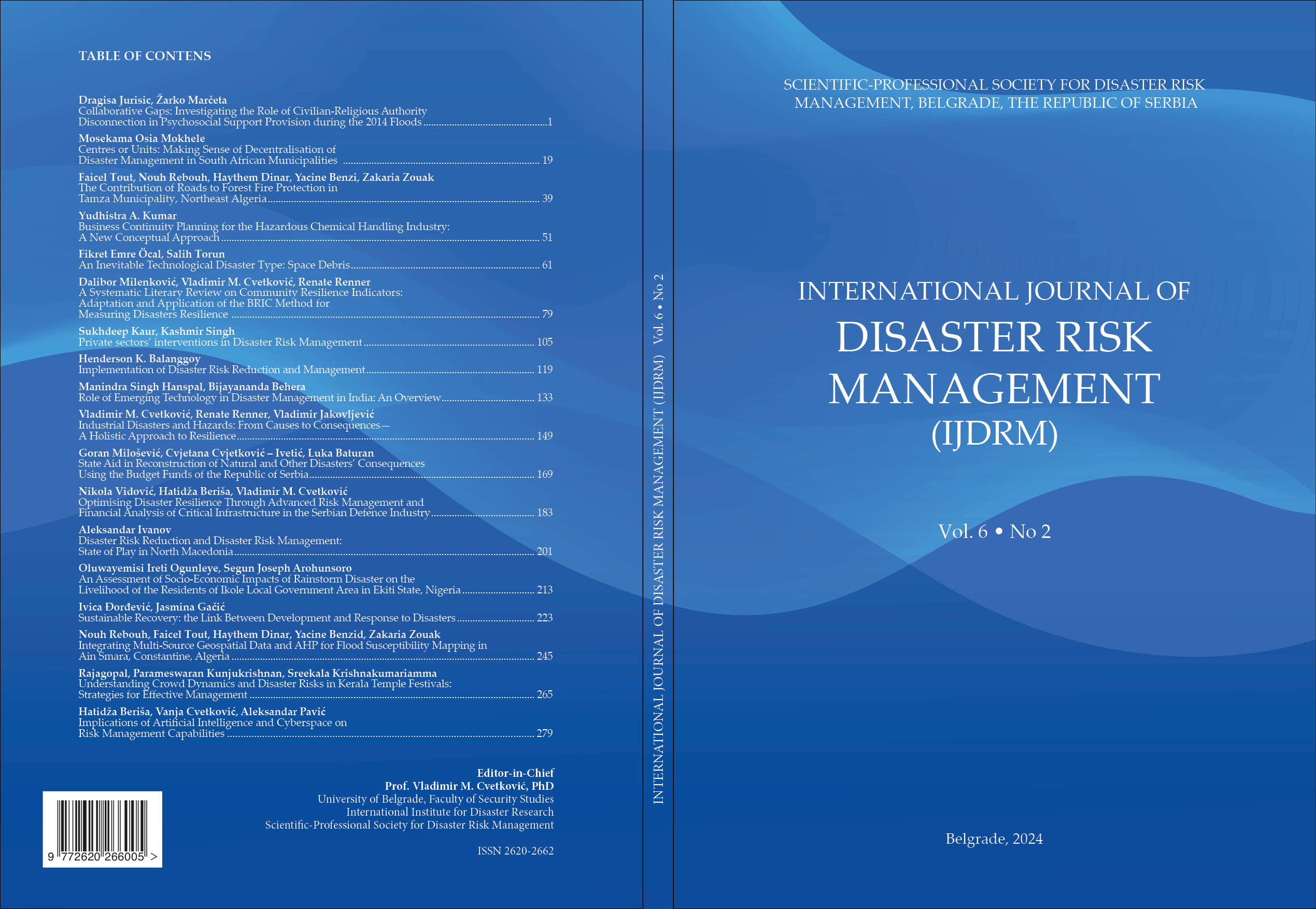
Vol. 6 No. 2 (2024)Published papers: 1) Collaborative Gaps: Investigating the Role of Civilian-Religious Authority Disconnection in Psychosocial Support Provision during the 2014 Floods; 2) Centres or Units: Making Sense of Decentralisation of Disaster Management in South African Municipalities; 3) The Contribution of Roads to Forest Fire Protection in Tamza Municipality, Northeast Algeria; 4) Business Continuity Planning for the Hazardous Chemical Handling Industry: A New Conceptual Approach; 5) An Inevitable Technological Disaster Type: Space Debris; 6) A Systematic Literary Review on Community Resilience Indicators: Adaptation and Application of the BRIC Method for Measuring Disasters Resilience; 7) Private sectors’ interventions in Disaster Risk Management; 8) Settings Implementation of Disaster Risk Reduction and Management; 9) Role of Emerging Technology in Disaster Management in India: An Overview; 10) Industrial Disasters and Hazards: From Causes to Consequences—A Holistic Approach to Resilience; 11) State Aid in Reconstruction of Natural and Other Disasters’ Consequences Using the Budget Funds of the Republic of Serbia; 12) Optimising Disaster Resilience Through Advanced Risk Management and Financial Analysis of Critical Infrastructure in the Serbian Defence Industry; 13) Disaster Risk Reduction and Disaster Risk Management: State of Play in North Macedonia; 14) An Assessment of Socio-Economic Impacts of Rainstorm Disaster on the Livelihood of the Residents of Ikole Local Government Area in Ekiti State, Nigeria; 15) Sustainable Recovery: the Link Between Development and Response to Disasters; 16) Integrating Multi-Source Geospatial Data and AHP for Flood Susceptibility Mapping in Ain Smara, Constantine, Algeria; 17) Understanding Crowd Dynamics and Disaster Risks in Kerala Temple Festivals: Strategies for Effective Management; 18) Implications of Artificial Intelligence and Cyberspace on Risk Management Capabilities.
-

International Journal of Disaster Risk Management (IJDRM)
Vol. 6 No. 1 (2024)Published papers: 1) A Systematic Collaboration of Volunteer and Professional Fire Units in Hungary; 2) Dynamics of Internal Migration in the Southwest Region of Bangladesh; 3) Psychological Preparedness of the Rescuers and Volunteers: A Case Study of 2023 Türkiye Earthquake; 4) Harmonization of Soft Power and Institutional Skills: Montenegro's Path to Accession to the European Union in the Environmental Sector; 5) Analyzing in Post COVID-19 era: The Effect of Occupational Stress and Work-Life Balance on Employees Performance; 6) Changes in Lulc and Drainage Network Patterns the Cause of Urban Flooding in Karachi City; 7) Management of COVID: The Creeping Disaster in the Indian Scenario; 8) Use of New Technologies in the Field of Protection and Rescue During Disasters.
-

International Journal of Disaster Risk Management (IJDRM)
Vol. 5 No. 2 (2023)Published papers: 1) Raised Under Bad Stars: Negotiating a Culture of Disaster Preparedness; 2) Social Capitals and Earthquake: A Study of Different Districts of Tehran, Iran; 3) Water Crisis in the Rangamati Hill District of Bangladesh: A Case Study on Indigenous Community; 4) Anticipated Role of Bangladesh Police in Disaster Management Based on the Contribution of Bangladesh Police during the Pandemic COVID 19; 5) A Predictive Model of Community Disaster Resilience based on Social Identity Influences (MODERSI); 6) Hazard risk evaluation of COVID-19: A case study
-

International Journal of Disaster Risk Management (IJDRM)
Vol. 5 No. 1 (2023)Published papers: 1) Dima Hasao, Assam (India) landslides’ 2022: A lesson learnt; 2) Risk Management of Gas Stations that Urban Expansion Crept into in the Gaza Strip; 3) Flood policy in Algeria; 4) Students’ perception of police readiness to respond to disasters caused by a COVID-19 pandemic; 5) Challenges of Women in Post-disaster Health Management: A Study in Khulna District; 6) Religion Influence on Disaster Risk Reduction: A case study of Serbia; 7) Factors Responsible for Urban Flooding in Karachi: A Case Study Of Dha
-

International Journal of Disaster Risk Management (IJDRM)
Vol. 4 No. 2 (2022)Published papers: 1) Disaster Risk Reduction Management Implementation in the Public Elementary Schools of the Department of Education, Philippines; 2) Level of coordination between the humanitarian and governmental organizations in Gaza Strip and its impact on the humanitarian interventions to the Internally Displaced People (IDPs) following May escalation 2021; 3) Remote Sensing and GIS Assessment of Domestic Fuel Energy Supply: A Threat to Global DRR Crusade in South-western Nigeria; 4) The Complacency of Flood Victims, Socio Economic Factors, and Effects and Vulnerabilities of Floods in Lower Kano Plains, Kisumu County, Kenya; 5) Seismic Vulnerability Assessment of Existing Buildings by Rapid Visual Screening Method: A Study on Ward 27 in Dhaka South City Corporation; 6) Resilience to natural disasters: A case study on southwestern region of coastal Bangladesh
-

International Journal of Disaster Risk Management (IJDRM)
Vol. 4 No. 1 (2022)Published papers: 1) International experiences in sheltering the Syrian refugees in Germany and Turkey; 2) Flood Research in Bangladesh and Future Direction: an insight from last three decades; 3) Methodology for the risk monitoring of geological hazards for buildings and structures; 4) Impact of 2016-2017 drought on household livestock assets and food security: the case of pastoralists and agro-pastoralists in Borana zone, southern Ethiopia; 5) Earthquake risk perception in Belgrade: implications for disaster risk management.
1-10 of 16
Next